

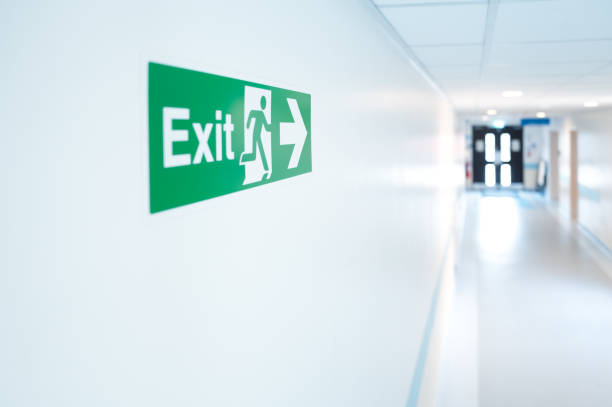
Choosing an exit sign is not only about meeting a code requirement. It is about making sure occupants can identify the nearest egress path quickly, clearly, and from the correct direction. In commercial buildings, warehouses, hospitality venues, offices, educational facilities, and multi-tenant sites, the viewing direction of an exit sign can affect visibility, travel decisions, and overall emergency response.
For businesses reviewing Emergency Lighting Perth requirements, one of the most practical questions is whether a single-face or double-face exit sign is the better option. The answer depends on building layout, line of sight, corridor design, mounting position, and how people are expected to move during an evacuation.
What Single-Face & Double-Face Exit Signs Actually Mean
A single-face exit sign displays the legend on one side only. It is designed for areas where people will approach the sign from one primary direction. This type is commonly used when the sign is mounted against a wall, above a doorway, or anywhere the intended audience will only view it head-on.
A double-face exit sign displays the legend on both sides. It is intended for locations where occupants may approach from two opposite directions. These signs are often suspended from ceilings or installed in open circulation paths where visibility is needed from both sides.
The difference may appear minor at first glance, but in practice it affects whether the sign can communicate the exit route effectively across a real space. If the wrong sign type is chosen, visibility may be reduced for one group of occupants, even if the sign itself is technically installed and illuminated.
Why Viewing Direction Matters in Emergency Egress
In an emergency, people do not stop to analyse the layout. They look for immediate visual guidance. Exit signage must therefore work within the natural sightlines of a building. If a sign is only visible from one direction in an area where people are moving from multiple approaches, it may not provide adequate directional support.
Viewing direction becomes especially important in:
- central corridors with traffic from both ends
- open-plan workspaces
- retail aisles leading to exit paths
- function venues with multiple access routes
- warehouse walkways
- school & healthcare corridors
- intersections where occupants can approach from either side
A sign should support rapid recognition, not force occupants to reposition themselves before understanding the route.
When a Single-Face Exit Sign Is the Right Choice
Single-face signs are generally appropriate where the installation position naturally limits viewing to one approach. This often includes wall-mounted applications or locations directly above a final exit door. In these cases, a second display face may provide no practical benefit.
Single-face signs are often suitable for:
Doorway Installations
Where the sign is fixed above a doorway and people approach from the front, a single-face configuration is usually sufficient.
Narrow Corridors With One Main Direction of Travel
In some buildings, occupants move toward the exit from a defined approach. If the reverse side will not be seen by building users, a double-face unit may be unnecessary.
Perimeter Walls
Where a sign is mounted flush to a wall, only one display surface is visible. A single-face sign is the logical option.
Smaller Rooms With Clear Exit Orientation
In compact spaces where the exit door is obvious and travel paths are limited, one visible face may provide enough guidance.
The benefit of using the correct single-face sign is that it aligns the fitting with the building’s actual geometry rather than adding capacity that will never be used.
When a Double-Face Exit Sign Is the Better Option
Double-face signs are valuable when the same exit path must be visible to occupants from two opposing directions. These fittings are commonly used in larger circulation zones and in areas where a suspended sign can provide early visual guidance before a person reaches the exit door itself.
Double-face signs are often the better choice for:
Ceiling-Hung Signs in Open Areas
Where a sign is suspended in a hallway, concourse, or open room, people may be moving toward it from both sides. A double-face display ensures visibility regardless of approach.
Long Corridors
In corridors with travel from opposite ends, a sign readable in both directions provides more effective wayfinding.
Intersections & Cross-Passage Routes
Where multiple routes merge into a common egress path, a double-face sign may improve visibility across the wider circulation zone.
Large Commercial & Industrial Spaces
Warehouses, showrooms, and larger commercial premises often have broader sightlines. In these environments, ceiling-mounted double-face signs can help occupants identify exits sooner.
For many businesses reviewing Emergency Lighting Perth installations, double-face signs are often the more suitable choice in shared access areas because they support visibility for a broader range of occupant movement patterns.
Key Factors That Influence the Choice
Selecting between single-face and double-face signage should be based on the physical environment, not preference alone.
1. Occupant Approach Direction
The first question is simple: from how many directions will people need to read the sign? If the answer is one, a single-face sign may be suitable. If the answer is two, a double-face sign is often the stronger option.
2. Mounting Location
Wall-mounted signs commonly suit a single-face format. Suspended ceiling-mounted signs often suit a double-face format. The mounting method should reflect how the sign will actually be viewed in use.
3. Corridor & Open-Space Layout
Straight corridors, intersecting hallways, open rooms, and multi-entry areas all create different visibility conditions. Sign direction should match those travel patterns.
4. Obstructions & Line of Sight
Partitions, shelving, racking, decorative bulkheads, and service equipment can interrupt visibility. A sign that works on a plan drawing may be less effective once real-world obstructions are considered.
5. Building Function
Hospitals, aged care sites, schools, warehouses, retail premises, hospitality venues, and offices all have different movement patterns. Occupant familiarity with the site also varies, which changes how important early sign recognition becomes.
A reliable fire safety Wholesale company Perth can assist businesses in selecting sign products that suit the site layout, ceiling condition, mounting method, and overall compliance requirements.
Common Mistakes in Exit Sign Selection
Poor exit sign outcomes often result from oversimplified product selection rather than installation failure. Common mistakes include:
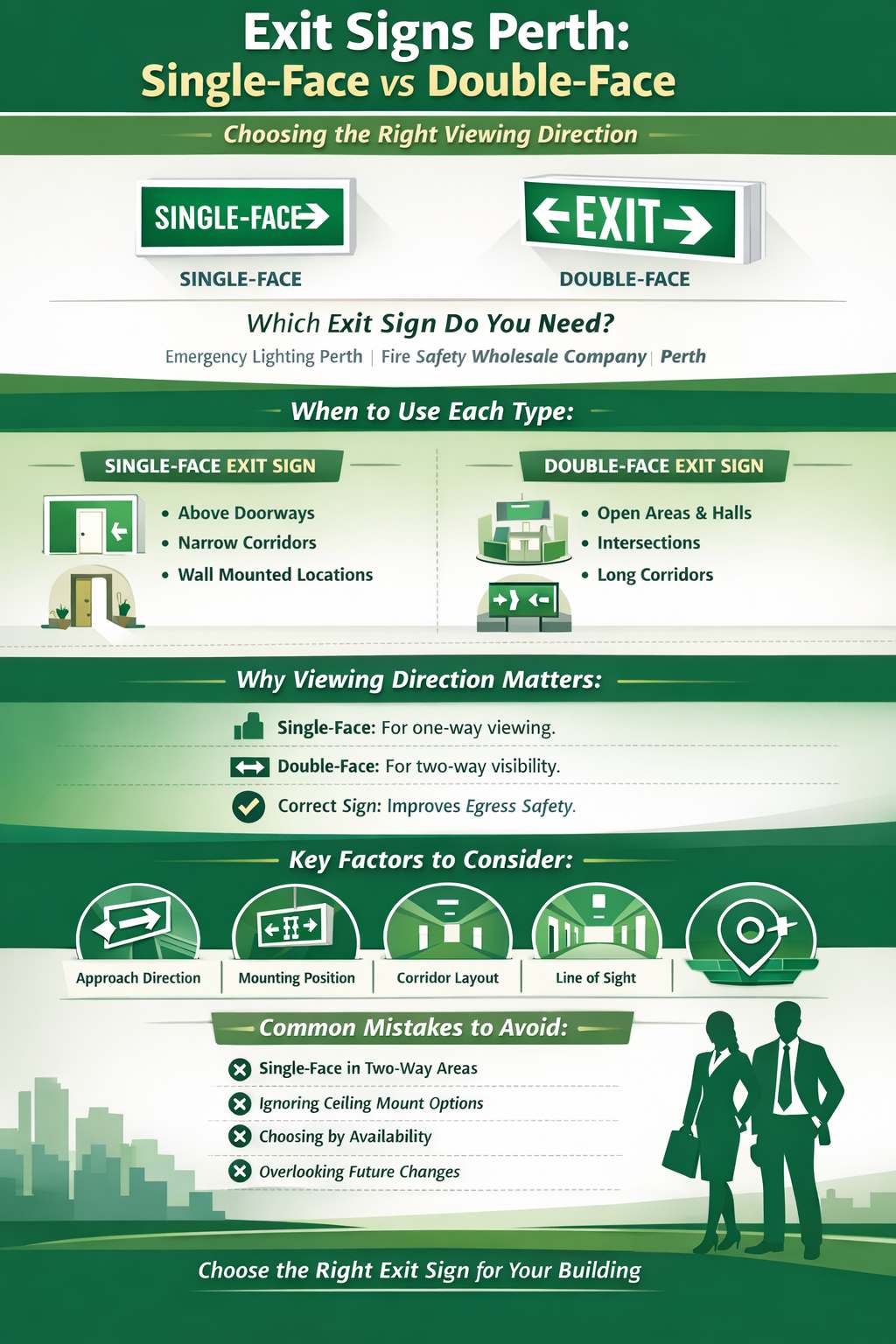
Using Single-Face Signs in Two-Way Approach Zones
This can leave one side of the path without visible signage.
Choosing by Product Availability Rather Than Layout
The easiest sign to source is not always the correct sign for the viewing angle required.
Ignoring Ceiling Suspension Opportunities
Some spaces benefit more from an overhead double-face sign than a wall sign positioned too close to the exit point.
Overlooking Future Fit-Out Changes
Racking, partitions, or refurbishments can alter sightlines. Sign direction should still work if the space changes within normal operating use.
Treating All Exit Routes the Same
One building may require both single-face and double-face signs depending on specific areas and path geometry.
Working with a specialist fire safety Wholesale company Perth helps reduce these selection errors because product choice can be matched to the actual use case rather than a generic specification.
Viewing Direction Should Support Faster Decision-Making
The purpose of exit signage is to assist immediate orientation. A sign that is visible only after a person changes position or passes a key junction is less effective than one that provides clear guidance from the correct approach. Single-face and double-face signs each have a valid role, but the correct choice depends on whether the sign needs to communicate to one direction of travel or two.
In most buildings, the best approach is not to standardise every sign type across the property, but to assess each location according to sightline, approach direction, and mounting position. That produces a more functional exit path network and a more practical safety outcome.
Conclusion
Choosing between single-face and double-face exit signs is a visibility decision as much as a compliance one. Single-face signs are generally suitable for wall-mounted positions and one-direction approaches, while double-face signs are better for suspended mounting and two-way viewing conditions. When the viewing direction is matched correctly to the building layout, exit signage becomes clearer, faster to recognise, and more useful during an evacuation.
For businesses assessing exit path visibility, product selection should always reflect how occupants will actually move through the space. That is the basis for choosing the right sign direction with confidence.
