


When selecting exit signs and emergency luminaires, IP rating is one of the most practical technical details to assess. In Perth buildings, the difference between an indoor corridor and a semi-exposed walkway can determine whether a fitting performs reliably or fails early through dust, moisture, or environmental wear. For contractors, facility managers, strata managers, and maintenance teams, understanding IP ratings helps match the product to the installation environment rather than relying on appearance alone.
This matters because not every exit light is being installed in a fully enclosed, climate-stable area. Many sites include covered external paths, loading areas, breezeways, car park links, plant access points, stair landings, and open-sided corridors. These locations are not fully outdoors, but they are also not protected to the same degree as an internal office or hallway. In those cases, the enclosure rating of the fitting becomes a key part of product selection.
What an IP rating actually means
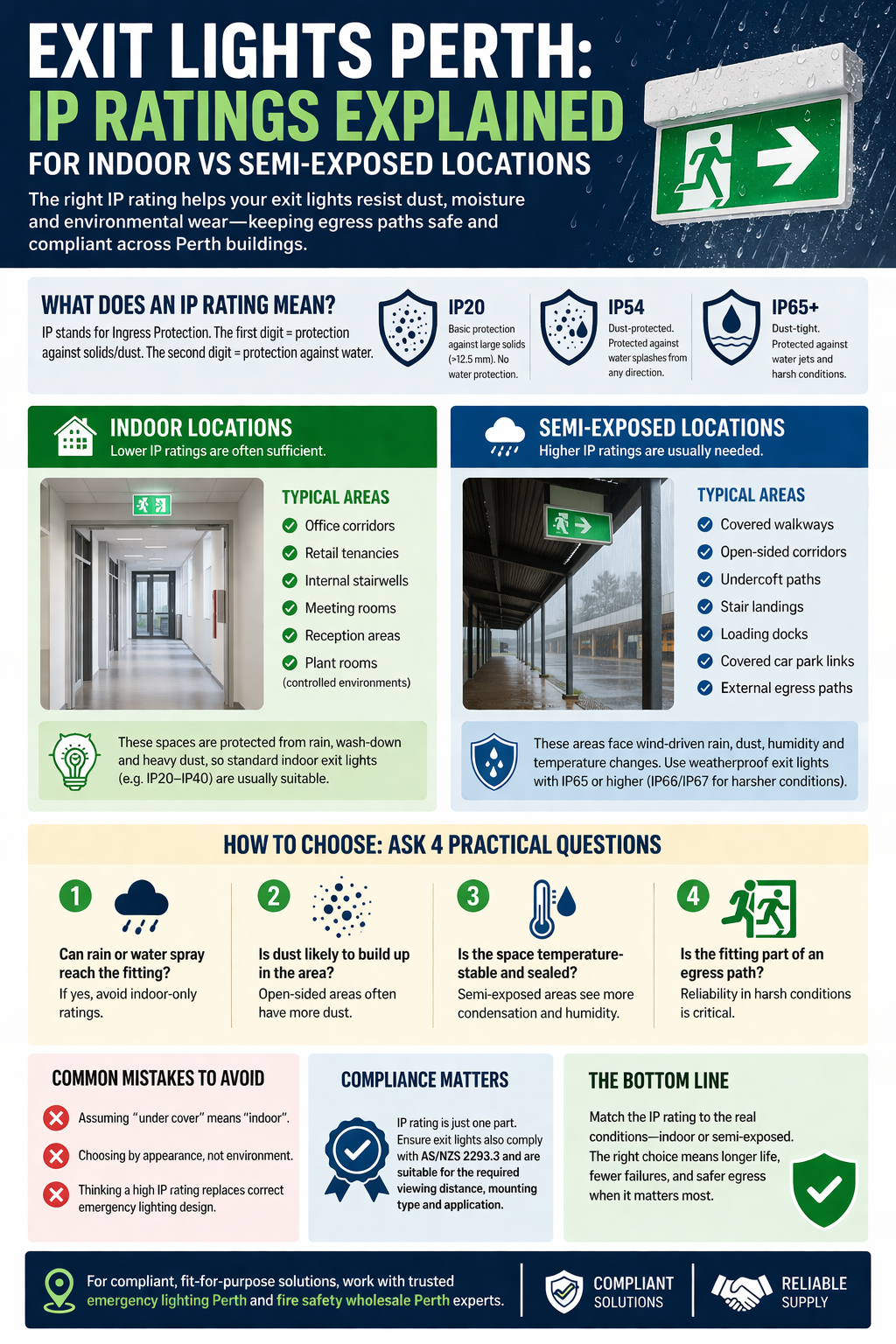
IP stands for Ingress Protection. The rating system is defined under IEC 60529 and grades how well an enclosure resists the entry of solids such as dust and liquids such as water. The first digit relates to protection against solid objects or dust, while the second digit relates to water protection. A higher number generally indicates a greater level of enclosure protection.
For example:
- IP20: Protected against solid objects larger than 12.5 mm, with no specific water protection
- IP54: Dust-protected with protection against water splashing from any direction
- IP65: Dust-tight with protection against water jets
This does not mean a higher IP rating is automatically better for every project. It means the fitting is designed for more demanding conditions. The correct choice depends on where the exit light is being installed and what the area is exposed to in normal operation.
Why IP ratings matter for exit lights in Perth
Perth buildings often include transition spaces that create confusion during specification. A corridor inside a shopping centre is straightforward. A covered walkway in an apartment complex is less straightforward. A stairwell with open sides, a service passage near roller doors, or a sheltered external path may look protected, but wind-driven rain, airborne dust, humidity, and temperature variation can still affect the fitting over time.
That is why emergency lighting Perth projects should assess the real environmental conditions of the installation point, not simply whether the area is technically under a roof. Ingress protection is relevant because moisture and dust can shorten fitting life, interfere with electronics, reduce optical performance, and increase maintenance exposure if the enclosure is not suited to the space. IEC explains that IP ratings are specifically intended to classify enclosure resistance to intrusion from dust and liquids, which is the basis for these decisions.
Indoor locations: where standard IP ratings are often suitable
In typical indoor environments, lower IP-rated exit lights are often appropriate. This includes:
- internal office corridors
- enclosed retail tenancies
- internal stairwells
- meeting rooms
- reception areas
- fully enclosed hallways
- plant rooms with controlled conditions
In these areas, the fitting is usually protected from rain, wash-down, condensation drift, and airborne contamination. A standard indoor enclosure may be sufficient provided the rest of the product specification also suits the compliance and visibility requirements of the site.
Manufacturers commonly separate indoor and weatherproof ranges for this reason. Clevertronics, for example, distinguishes between indoor applications and weatherproof models in its technical documentation and product categories.
For wholesale buyers, electricians, and builders sourcing through fire safety wholesale Perth channels, this distinction is commercially important. Over-specifying every fitting to a weatherproof level can add unnecessary cost, while under-specifying creates premature replacement risk.
Semi-exposed locations: where a higher IP rating is usually needed
A semi-exposed location is generally an area that is not fully open to the weather but is still vulnerable to environmental exposure. Typical examples include:
- covered external walkways
- open-sided corridors
- undercroft paths
- stair landings open to air movement
- loading dock access routes
- covered car park links
- external egress paths under awnings
These areas may be shielded from direct rainfall above, but they can still receive blown rain, mist, dust, humidity, and airborne debris. In practice, this often moves the specification away from standard indoor fittings and toward products with stronger enclosure protection.
Manufacturers of emergency lighting products in Australia commonly specify IP65 or above for weatherproof applications. Legrand lists IP65 weatherproof exit signs for installations needing protection against dust, water, and environmental stress, while Clevertronics offers weatherproof exit ranges up to IP66/67 for applications requiring greater resistance.
That does not mean every semi-exposed area automatically requires the highest available rating. It means specifiers should assess how exposed the location actually is. A covered walkway in a quiet internal courtyard is different from a breezeway facing prevailing weather. The more exposure there is to moisture and dust, the more enclosure performance matters.
Indoor vs semi-exposed: a practical way to decide
A useful way to approach product selection is to ask four practical questions:
1. Can rain or water spray reach the fitting?
If wind-driven rain, hose cleaning, wash-down activity, or moisture drift can reach the unit, an indoor-only rating is usually not enough.
2. Is dust likely to build up in the area?
Open-sided locations near roads, plant areas, car parks, or service yards often experience more dust intrusion than enclosed interiors.
3. Is the space temperature-stable and sealed?
If the space is not fully enclosed, it is more likely to experience condensation, fluctuating humidity, and airborne particles.
4. Is the fitting part of an egress path that must remain reliable in harsher conditions?
Exit lights are life-safety products. Reliability in normal conditions is not the only consideration; performance during an incident also matters.
This is why emergency lighting Perth specifications should be based on site conditions rather than product habit. A fitting that performs well in a sealed office corridor may not be the right choice for a covered apartment walkway or loading area link.
The role of compliance and product classification
Ingress protection is only one part of selecting an exit light. Compliance with the relevant emergency lighting standards and correct classification for viewing distance, mounting type, and application still matter. Australian emergency lighting manufacturers regularly reference AS/NZS 2293.3 compliance in their product ranges, including indoor and weatherproof emergency fittings.
That means the decision is not simply “indoor or outdoor”. It is a combined assessment of:
- compliance
- enclosure protection
- mounting method
- environment
- maintenance needs
- expected service life
For procurement teams buying through fire safety wholesale Perth suppliers, this supports a more accurate specification process. The goal is not only to buy a compliant exit light, but to buy one that is appropriate for the exposure level of the installation point.
Common mistakes when selecting exit lights by IP rating
A frequent mistake is assuming that “under cover” means “indoor”. In many Perth properties, under-cover areas still experience enough weather movement to justify a weatherproof fitting.
Another mistake is choosing by appearance rather than environment. A slim indoor exit sign may look suitable for a semi-exposed stair landing, but appearance does not reflect enclosure performance.
A third mistake is treating IP rating as the only technical requirement. A high IP rating does not replace the need for correct emergency lighting design, compliant spacing, suitable viewing distance, and proper installation.
Final point
IP ratings are not a minor specification detail. They are a practical indicator of whether an exit light is suited to the environment where it will actually operate. For enclosed internal areas, a standard indoor fitting may be appropriate. For semi-exposed locations, a higher level of ingress protection is often the safer and more durable choice. In Perth projects, the best results come from matching the fitting to the true site conditions, not just the building label attached to the space.
